


Your customers ask before they buy.
Check if you're recommended.

Free scan. No credit card. Results in < 60 seconds.

ChatGPTChatGPT
Live
GeminiGemini
(coming soon)
PerplexityPerplexity
(coming soon)
CopilotCopilot
(coming soon)
Meta AIMeta AI
(coming soon)
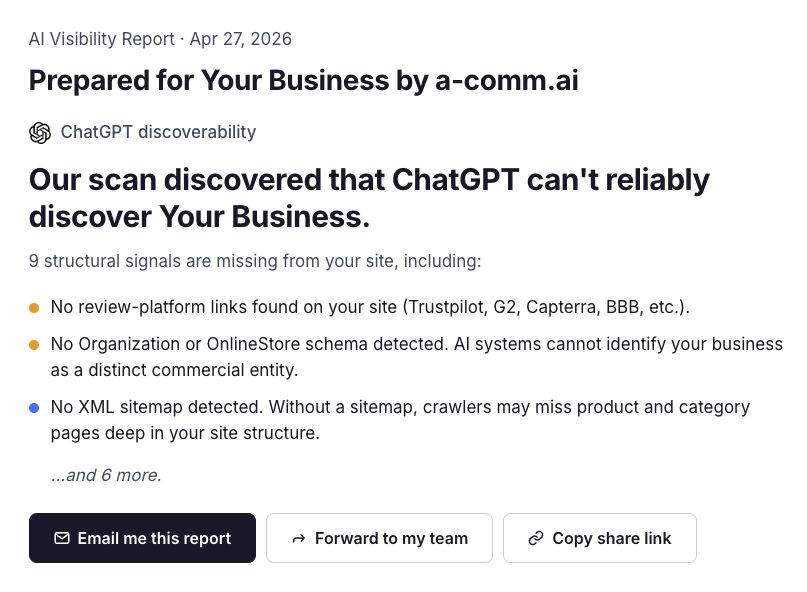
A-Comm.ai AI Visibility Report — sample showing ChatGPT discoverability findings for a business

Before an agent can recommend a product, it has to recognize the business.

The Business Scanner is the entity audit layer. Next is your product layer. You don’t want ChatGPT recommending Blockbuster for Bridgerton.

Agentic commerce is scaling fast.
The next dispute wave is too.

Existing protocols define how agents discover, transact, and pay. None define the evidence standard for the dispute risk that follows.

Until now.

UCP
Universal Commerce Protocol
GoogleShopify
ACP
Agentic Commerce Protocol
OpenAIStripe
AP2
Agent Payments Protocol
Google
TAP
Trusted Agent Protocol
Visa
Agent Pay
Agentic Tokens
Mastercard
SPT
Shared Payment Tokens
Stripe
APP
Agentic Product Protocol
Klarna
UCP
Universal Commerce Protocol
GoogleShopify
ACP
Agentic Commerce Protocol
OpenAIStripe
AP2
Agent Payments Protocol
Google
TAP
Trusted Agent Protocol
Visa
Agent Pay
Agentic Tokens
Mastercard
SPT
Shared Payment Tokens
Stripe
APP
Agentic Product Protocol
Klarna
Live · Worldwide commerce risk last 24h
Counters reset daily at 00:00 UTC (5:00 PM PT · 8:00 PM ET).
$0
Global card fraud
Direct fraud losses on payment cards worldwide.
Liability splits between issuers and merchants.
Source: Nilson Report #1259 (Feb 2024)
$0
Merchant total cost of fraud
Every $1 of raw fraud costs merchants $3 in ops, chargeback fees, labor, and lost revenue.
Source: LexisNexis True Cost of Fraud 2023 × Nilson
Agent-originated transactions aren’t in either number. They’re coming.

How the counters are calculated

Both numbers tick from a rate derived from annual industry data divided by seconds in a year, then accumulated from the start of the current UTC day.

Global card fraud (2024)$34.35B
÷ seconds per year31,536,000
Rate$1,089 / sec
Global card fraud (2024)$34.35B
× merchant cost multiplier3.0×
Merchant total cost of fraud$103.05B / yr
÷ seconds per year31,536,000
Rate$3,268 / sec
Sources:
Nilson Report Issue #1259 (Feb 2024) — global card fraud base.
LexisNexis Risk Solutions True Cost of Fraud Study 2023 — merchant cost multiplier. The study reports a multiplier of $3.75 for US-only merchants; we use a globally-weighted 3.0x here to stay conservative.

Introducing
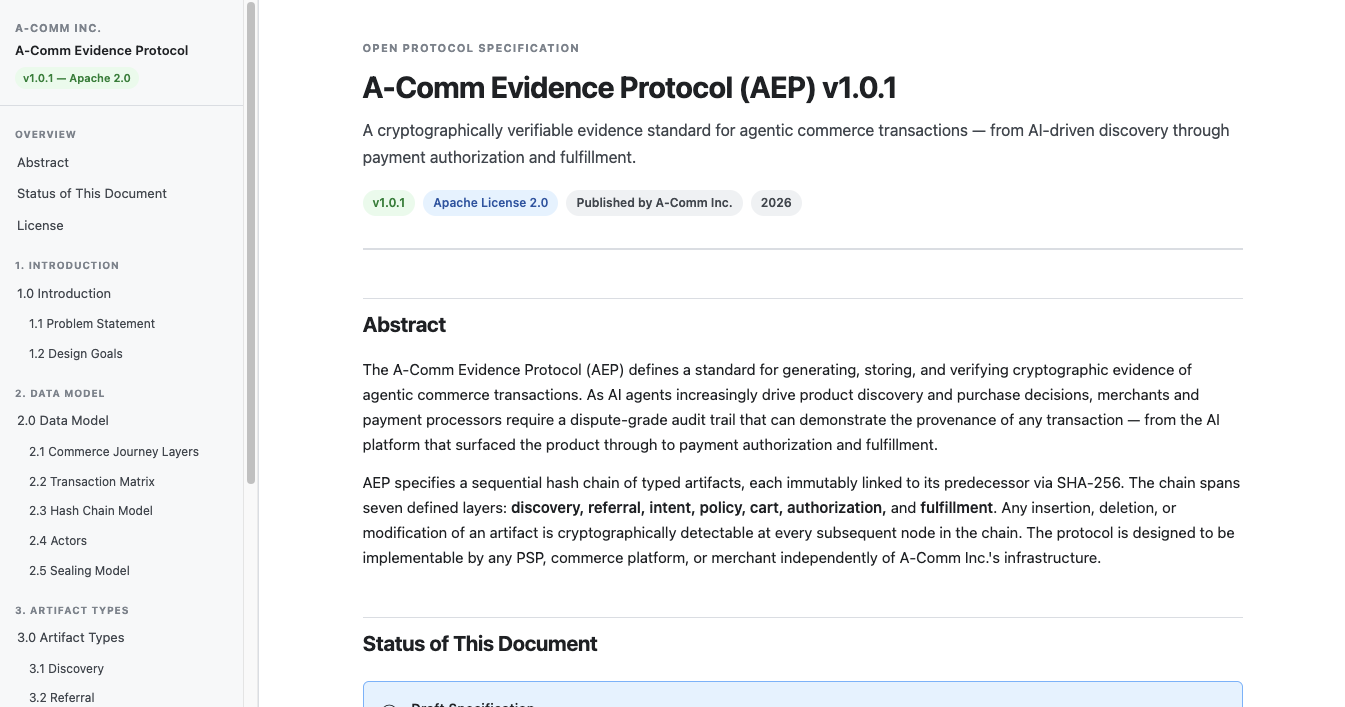
A-Comm Evidence Protocol.

Patent pending.

The missing standard for the chargeback era ahead.

Payments have rails. Disputes have workflows. Agentic commerce needs evidence. AEP links discovery through purchase and fulfillment into an immutable record that holds up in chargebacks, compliance review, and audit. Before you need it.

See AEP in action.

Every AI-led purchase, cryptographically sealed.

From the first agent citation to the final receipt and fulfillment, A-Comm captures each step of the transaction into a tamper-evident chain. Watch one form in real time.


*For illustration purposes only; see AEP spec for full evidence chain.
Evidence chain · AEP 1.0
Waiting
01
Discovery
0x9a3f7c82d4e1b508...4f82
02
Intent
0x7e4a21f8c091ab3d...54a7
03
Delegation
0x5e2c8a4f91b0d3e7...7a91
04
Authorization
0x9c8d4b2e07a1f3c6...8d12
05
Fulfillment
0x3f7e1a94b208c5d0...123f
Chain sealed · integrity verified
SHA-256 · 5 blocks · tamper-evident

Built for how you run your business.

Shopify
WooCommerce
BigCommerce
Magento
Stripe
Adyen
Square
PayPal
Checkout.com
Visa
Mastercard
American Express
Discover
Apple Pay
Google Pay
Shop Pay
Klarna
Afterpay
Affirm

Complements network enforcement

Works alongside Visa Intelligent Commerce (TAP, Payment Instructions, AI-Ready Cards, Verifi) and Mastercard Agent Pay (Verifiable Intent, Agent Pay, Ethoca). Enforcement prevents disputes on each rail. AEP provides cross-network evidence when disputes occur.

Exports to dispute management

DisputeBundle JSON plugs into your existing dispute and fraud workflows. Compatible with Chargebacks911, Midigator, Sift, Kount, Riskified, Justt, and any in-house dispute ops team. We provide the evidence. They run the workflow.

Start with a free scan.

See if your business is discoverable by ChatGPT.

Frequently asked questions

The scanner audits whether your website is structured to be discovered, cited, and recommended by AI agents. It evaluates four layers: crawlability and access (can the AI’s crawler reach your site, is your robots.txt configured correctly), entity clarity (is your business name, address, and identity unambiguous on the page and in third-party sources), structured data coverage (Schema.org Organization, LocalBusiness, FAQ, sameAs, canonical), and authority signals (review density, content freshness, partner-directory presence). The report grades each gap, weights it by impact, and ties it to the exact field, page, or directory that needs to change.
ChatGPT is the most-used AI agent for commerce queries today, and its discoverability requirements (Foursquare entry, Schema.org Organization on the website, OAI-SearchBot crawl access, Knowledge Graph entity coherence) are the most fully-documented of the four. Gemini (Google Business Profile + Knowledge Graph + Google-Extended), Perplexity (Yelp + PerplexityBot + publisher partnerships), Copilot (Bing Places + Bingbot + Microsoft Merchant Center), and Meta AI each ship as their own per-platform evaluator on the post-pilot roadmap. Each platform uses different data infrastructure — A-Comm.ai treats them as independent products, never blending one platform’s signals into another platform’s score.
No. AI agents and search engines retrieve from different infrastructure. Google ranks pages on a backlink-and-engagement signal stack; ChatGPT discovers businesses through Foursquare entries, structured data on the page, and the OAI-SearchBot crawl. A site can be #1 on Google for “best [type of business] in [city]” and completely invisible to ChatGPT for the same query. The two surfaces have to be solved separately.
The report is a punch list. Every gap names the exact field, page, or directory that needs to change — so you can act on it directly. Three practical paths:
  • Fix it in-house. Hand the report to your developer or webmaster. Most structural fixes (Schema.org Organization JSON-LD, sameAs links, canonical URLs, robots.txt entries for OAI-SearchBot) are 30-minute changes a developer can ship the same day.
  • Send it to your agency or freelancer. Each gap is platform-spec’d, so an outside vendor doesn’t need to guess at what ChatGPT requires.
  • Claim and verify your third-party entries directly. Foursquare (the structural source ChatGPT pulls from), Google Business Profile (Gemini), Yelp (Perplexity), and Bing Places (Copilot) can each be claimed in under 10 minutes per platform.
Want it done for you? The automated fix-execution side of A-Comm.ai is in closed beta — see the cost question below for how to get access.
AEP is an open specification for capturing the evidence chain of an agent-originated transaction: discovery → session → intent → delegation → authorization → outcome. Each step is timestamped, cryptographically hashed (SHA-256), and linked to the prior step, producing a tamper-evident record that holds up in chargeback representment, compliance review, and audit.
A consumer who buys through a chat agent reaches the merchant’s checkout carrying almost none of the structured context the merchant or issuer needs to defend a chargeback. There’s no record of which AI surface the consumer started on, what intent they expressed in the conversation, what delegation authority the agent was operating under, or which cart maps to which authorization. Card-not-present took fifteen years to build that data layer — AVS, CVV2, 3-D Secure, tokenization, Compelling Evidence 3.0. Agent-originated transactions are back at the 1999 position, and the volume is arriving now, not in 2040.
When a dispute is filed, the merchant exports a DisputeBundle JSON from the AEP evidence vault. The bundle contains the full hash chain — discovery surface, conversation summary, item selection, delegation grant, authorization match, fulfillment record — formatted to plug into existing dispute-management tools (Chargebacks911, Midigator, Sift, Riskified, Justt, in-house ops). Issuers and arbitrators can verify each hash independently. AEP doesn’t run the dispute workflow; it provides the evidence the workflow has been missing.
A dispute-evidence format is only useful when every party in the transaction can read it — issuers, networks, acquirers, PSPs, dispute-management vendors, and merchants of every size on every commerce platform. A proprietary format would lock the value inside one vendor; an open spec lets the entire industry adopt and extend it. The pattern is proven: AVS, CVV2, 3-D Secure, and tokenization were each standardized outside any single vendor and became universal because they were open. AEP follows that pattern. A-Comm.ai is the first reference implementation, not the gatekeeper.
The Business Scanner is completely free — no credit card required. Everything else A-Comm.ai is building (automated fix execution, continuous monitoring, citation-rate tracking) is currently in closed beta. If you’d like to participate — including white-glove service where the founding team implements fixes for you — request access after your scan completes by contacting us at contact@a-comm.ai.

Subscribe for Agentic Commerce
News & Analysis.

Weekly updates on AI shopping agents, business and product discovery, the future of disputes and chargebacks, and more.